- Variable Capacitance Technology
- 6 Degrees of Freedom Measurements
- Hermetically Sealed
- DC Response
- International Traffic in Arms Regulation (ITAR) Free
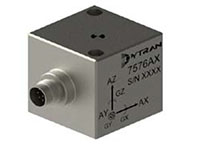
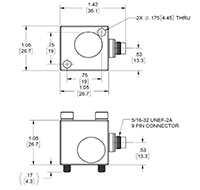
| Items |
 7576A1 6DOF 49.1 Meter Per Second Square (m/s²) Accelerometer Input Vibration Sensor |
7576A2 6DOF 98.1 Meter Per Second Square (m/s²) Accelerometer Input Vibration Sensor |
7576A3 6DOF 294 Meter Per Second Square (m/s²) Accelerometer Input Vibration Sensor |
7576A5 6DOF 19.6 Meter Per Second Square (m/s²) Accelerometer Input Vibration Sensor |
||||
| Description |
|
|||||||
| Brands | Dytran | |||||||
| Sensor Type | Vibration | |||||||
| Maximum Weight | 1.9 oz55 g | |||||||
| Connector Type | 5/16-32 United Extra Fine (UNEF-2A) | |||||||
| Material | Ti-6AI-4V | |||||||
| Accelerometer Input Range (±) | 5 g49.1 m/s² | 10 g98.1 m/s² | 30 g294 m/s² | 2 g19.6 m/s² | ||||
| ±5 Percent Accelerometer Frequency Response | 0 to 1000 Hz | 0 to 600 Hz | 0 to 1000 Hz | 0 to 700 Hz | ||||
| Accelerometer Frequency Response at ±3 Decibel (dB) Bandwidth | 0 to 1300 Hz | 0 to 2500 Hz | 0 to 3000 Hz | 0 to 1150 Hz | ||||
| Nominal Scale Factor1 | 470 mV/g47.9 mV/m/s² | 235 mV/g24.0 mV/m/s² | 78.33 mV/g8.0 mV/m/s² | 1175 mV/g119.8 mV/m/s² | ||||
| Typical Output Noise | 0.000019 g rms/√ Hz0.00019 m/s²/√ Hz | 0.00004 g rms/√ Hz0.0004 m/s²/√ Hz | 0.000089 g rms/√ Hz0.0009 m/s²/√ Hz | 0.0000088 g rms/√ Hz0.00009 m/s²/√ Hz | ||||
| Typical Accelerometer Full Scale (F.S.) Non-Linearity2 | 0.2 % | |||||||
| Accelerometer Temperature Range | -67 to 257 ºF-55 to 125 ºC | |||||||
| Scale Factor Temperature Coefficient3 | 67 ppm/ºF120 ppm/ºC | |||||||
| Maximum Axis Misalignment | 10 mrad | |||||||
| Shock Survivability | 6000 g58860 m/s² | |||||||
| Accelerometer Resonant Frequency | 3 kHz | >2.8 kHz | >5 kHz | 1.2 kHz | ||||
| Maximum Accelerometer Cross Axis Sensitivity | 5 % | |||||||
| Gyro Input Range (±) | 50 º/sec | 150 º/sec | 250 º/sec | 50 º/sec | ||||
| Gyro Frequency Response | 1 to 1000 Hz | 1 to 3000 Hz | 0.01 to 2500 Hz | 1 to 1000 Hz | ||||
| ±10 Percent (%) Sensitivity4 | 25 mV/º/sec | 12.5 mV/º/sec | 7.0 mV/º/sec | 25 mV/º/sec | ||||
| Typical Noise Density Rate | 0.04 (º/sec)/√ Hz | 0.04 (º/sec)/√ Hz | 0.06 (º/sec)/√ Hz | 0.04 (º/sec)/√ Hz | ||||
| Typical Gyro Full Scale (F.S.) Non-Linearity5 | 0.2 % | |||||||
| Gyro Temperature Range | -40 to 221 ºF-40 to 105 ºC | |||||||
| Gyro Resonant Frequency | 14.5 kHz | 14.5 kHz | 5.7 kHz | 14.5 kHz | ||||
| Maximum Gyro Cross Axis Sensitivity | 5 % | |||||||
| Nominal Output Impedance | 2 O | |||||||
| Direct Current (DC) Operating Voltage | 6 to 14 V | |||||||
| Direct Current (DC) Operating Bias Voltage | 2.5 V | |||||||
| Direct Current (DC) Operating Bias Voltage Tolerance (±) | 0.5 V | |||||||
| Typical Operating Direct Current (DC) | 23 mA | |||||||
| Maximum Operating Direct Current (DC) | 28 mA | |||||||
| Power Supply Rejection Ratio | >65 dB | |||||||
| Storage Temperature | -67 to 257 ºF-55 to 125 ºC | |||||||
| Environmental Seal | Hermetic | |||||||
| Supplied Accessories |
|
|||||||
| Note |
In the interest of constant product improvement, we reserve the right to change specifications without notice. It is the customer's responsibility to validate that a particular product with the properties described in the product specification is suitable for use in a particular application. Parameters provided in datasheets and / or specifications may vary in different applications and performance over time. All operating parameters, including typical parameters, must be validated for each customer application by the customer's technical experts. Units on the line drawing are in inches. |
|||||||
|
||||||||
