Dytran series of signal conditioners are microprocessor controlled, 3 channel units used for various types of sensors.
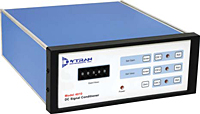
| Items |
4010 Dytran 4010, Microprocessor Controlled 3-Channel Direct Current (DC) Signal Conditioner |
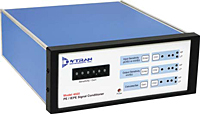 4020 Dytran 4020, Microprocessor Controlled 3-Channel Signal Conditioner |
||
| Description |
The Dytran model 4010 is a microprocessor controlled, 3-channel DC signal conditioner
amplifier designed for use with bridge-type or differential output accelerometers and
pressure sensors for a variety of general purpose laboratory testing applications. Units
incorporate a variable gain adjustment, shunt calibration capability and multiple
excitation level settings. A microprocessor SLEEP mode is utilized to eliminate high frequency clock noise and their associated harmonics. The microprocessor WAKES momentarily to acknowledge front panel switch depressions then goes to SLEEP immediately after processing and executing the requested function. This allows the amplifiers to operate within minimum self generated noise and provides clean, clock free signals. The Dytran model 4010 incorporates dual 12-bit DAC’s for each channel, to auto-zero the input and output amplifiers for DC input signals. Input signals with magnitudes of ±10 VDC can be zeroed. A unique output DAC trimming routine allows trimming the output zero within ±1 mVDC. The transducer excitation supplies are individually adjustable for each channel from 0.00 to 12.00 VDC. Any setting above 12.00 VDC will generate an excitation voltage of 12.10 VDC. The outputs are short circuit protected and can supply up to 30 mA each. Remote sense leads are provided to eliminate errors caused be long cable lengths. |
The Dytran model 4020 is a microprocessor controlled 3-channel signal conditioner for
both charge mode and IEPE sensors. When used with charge mode sensors, the model
4020 incorporates a charge amplifier and when used with IEPE sensors, units incorporate
an integral 4 or 10 mA, user selectable, current source with 20 VDC compliance voltage. A
user friendly interface allows programming input sensitivity and output sensitivity, then
allowing the instrument to calculate the amplifier gain. All gain selections are stored in
non-volatile memory and reinitialized when power is applied. Gain can also be entered
directly if desired. A microprocessor SLEEP mode is utilized to eliminate high frequency clock noise and their associated harmonics. The microprocessor WAKES momentarily to acknowledge front panel switch depressions then goes to SLEEP immediately after processing and executing the requested function. This allows the amplifiers to operate within minimum self generated noise and provides clean, clock free signals. The 4020 also uses low noise linear voltage regulators instead, as opposed to switching regulators, to minimize interference. For each channel, the model 4020 uses 12 bit DACs to set amplifier gains from 0.00 to 999.9 with 0.5% precision. Amplifier gains can be changed on-the-go without damage to the instrument. A rear panel voltage selector switch allows selection of 100, 115 or 230 VAC, 50-60Hz, input power. |
||
| Brands | Dytran | |||
| Channels | 3 | |||
| Height | 3.3 in8.3 cm | |||
| Width | 8.3 in21.0 cm | |||
| Depth | 9.3 in23.5 cm | |||
| Input Connector Type | D-SUB, 9-Pin | Bayonet Neill-Concelman (BNC) Jack | ||
| Output Connector Type | Bayonet Neill-Concelman (BNC) Jack | |||
| Power Source | 50 to 60 Hz, line | |||
| Gain | 0.01 to 9999 | |||
| Quality Management System |
Dytran Instruments Quality Management System meets the requirements of the following standards:
|
|||
|
|
||||
